Foot Focus Podiatry

Mon - Fri : 08:30 - 5:30   |   reception@footfocuspodiatry.com.au
08 9258 4152 |
Google Review
logo foot focus
foot focus podiatry
logo foot focus
logo foot focus

Understanding Your Foot Calluses: What Your Skin Is Trying to Tell Us

A callus forms because your skin is trying to protect itself. Callus tissue is much stiffer than normal skin. When your foot rubs against your shoe or the ground, this stiff skin moves as a single block, creating a pinch effect. This pinch leaves clues about exactly how weight and friction travel across your foot.

The Clues We Look For

  • The Shape of the Pinch: The way the skin gathers tells us the exact direction of the friction.
  • The Thickness: The thickest part of the callus shows us where your foot experiences the highest pressure.
  • Skin Lines: Deep, prominent lines in the skin mean there is a large amount of rubbing and sliding (shearing) in that spot.

Our 3-Step Assessment

  1. Read the Callus: We look closely at the thickness and lines to map out how your weight shifts while walking.
  2. Find the Cause: We figure out why your body is compensating and putting extra pressure on that specific spot.
  3. Fix the Problem: We create a treatment plan, like custom insoles (orthotics) or footwear changes, to balance out the pressure.

  • Winograd procedure- This procedure will be done in hospital setting under local and or general anaesthesia and it is reserved upon failure of the phenolization or if there is significant amount of skin overlapping the nail with soft tissue growth. This procedure involves removing a portion of the skin along with the nail down to the level of the bone. Sutures (stitches) will be applied to close the surgical site. The procedure takes about 10-15 minutes to be performed and your foot will be bandaged. You will be seen within first 5 days and then the sutures will be removed in 10-14 days. Currently this procedure can only be performed by Reza Naraghi (podiatric surgeon).  He will prescribe appropriate pain medication for your post-operative pain management. You will be in open sandal and or post op shoe for 2 weeks. This is not for everyone (especially if you don’t like seeing surgical procedures) but should you be keen to see a step by step process involved in a Winograd then please click here.
  • Zadik Procedure- This procedure is used with permanent total nail removal is desired. The indications for the procedure are significant ingrowing nail on both borders, thickened and painful nails and bony growth under the nailbed. This procedure can be done under local with sedation and or under general anaesthesia at a hospital and or day surgery centre. Sutures will be applied and will be removed 14 days post surgery. You can not get your foot wet and your foot will be in a sterile bandage for 2-3 weeks. You may need pain medication post surgery. On average it will take six weeks for your nail bed area to heal. Following that you can wear most close shoes.
  1. This procedure involves:
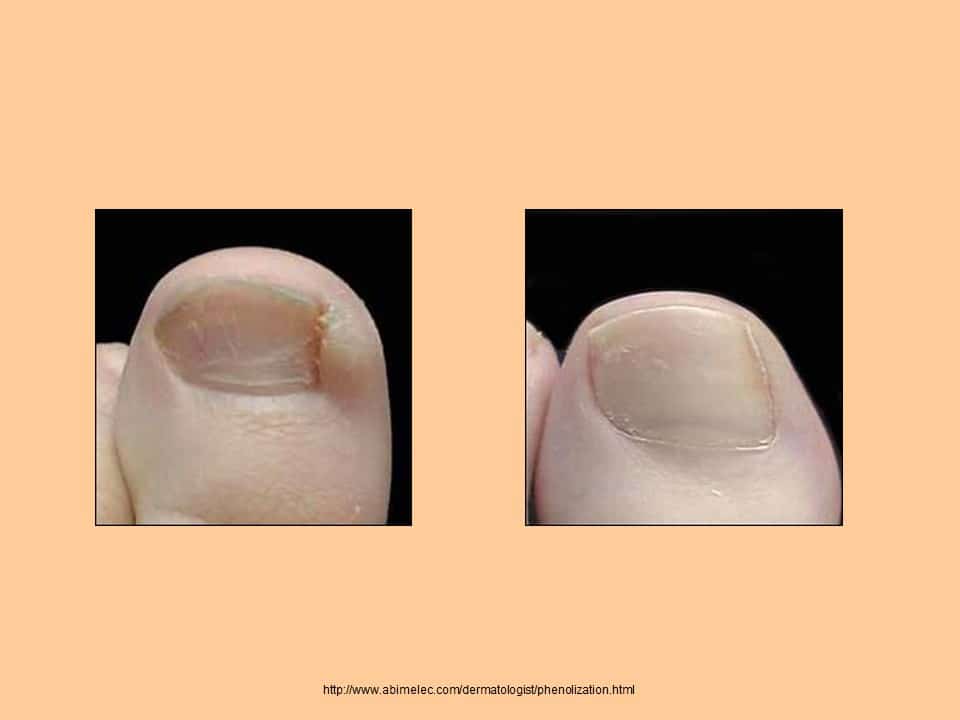
  • Removing the nail partially or totally and ablating (destroying) the root using a weak acid called phenol.
  • The phenol cause permanent ablation of the root of the offending nail and prevent ingrown nail recurrence.
  • The procedure is successful 95% of the time. The procedure takes about 10-15 minutes to perform.
  • It can be done in our rooms using local anaesthesia with or without sedation.

2. Post operative care:

  • Soak your toe.
  • Apply a daily dressing.
  • Wear open toe shoes for at least 3-4 days.
  • You may be required to take oral antibiotics

3. Pain management:

  • Most patients do not require pain medication
  • If needed, Panadol is usually sufficient
  • You can return to regular shoes after one week
  • This procedure is not suitable for everyone, especially those uncomfortable with surgical procedure
  • For those interested in seeing a step-by-step process of a partial nail matrixectomy with phenolisation, click here.
  • Winograd procedure- This procedure will be done in hospital setting under local and or general anaesthesia and it is reserved upon failure of the phenolization or if there is significant amount of skin overlapping the nail with soft tissue growth. This procedure involves removing a portion of the skin along with the nail down to the level of the bone. Sutures (stitches) will be applied to close the surgical site. The procedure takes about 10-15 minutes to be performed and your foot will be bandaged. You will be seen within first 5 days and then the sutures will be removed in 10-14 days. Currently this procedure can only be performed by Reza Naraghi (podiatric surgeon).  He will prescribe appropriate pain medication for your post-operative pain management. You will be in open sandal and or post op shoe for 2 weeks. This is not for everyone (especially if you don’t like seeing surgical procedures) but should you be keen to see a step by step process involved in a Winograd then please click here.
  • Zadik Procedure- This procedure is used with permanent total nail removal is desired. The indications for the procedure are significant ingrowing nail on both borders, thickened and painful nails and bony growth under the nailbed. This procedure can be done under local with sedation and or under general anaesthesia at a hospital and or day surgery centre. Sutures will be applied and will be removed 14 days post surgery. You can not get your foot wet and your foot will be in a sterile bandage for 2-3 weeks. You may need pain medication post surgery. On average it will take six weeks for your nail bed area to heal. Following that you can wear most close shoes.

Matrixectomy with phenolization – This procedure involves removing the nail partially or totally and ablating (destroying) the root using a weak acid called phenol. This will cause permanent ablation of the root of the offending nail and prevent ingrown nail recurrence. This procedure is successful 95% of the time. The procedure takes about 10-15 minutes and can be performed in our rooms using local anaesthesia with or without sedation. Post operatively you will be required to soak your toe and apply a daily dressing. Wearing open toe shoes for at least 3-4 days is recommended. You maybe required to take oral antibiotics. Most patients do not require pain medication following the procedure, and if needed Panadol is sufficient for pain management. You can go back to regular shoes after one week.  This is not for everyone (especially if you don’t like seeing surgical procedures) but should you be keen to see a step by step process involved in a partial nail matrixectomy with phenolisation then please click here.